
Mentor Teachers: Paying It Forward, One Conversation at a Time
Serving as a mentor teacher—supporting and preparing the next generation of educators—is a vital role in addressing the teacher pipeline and responding to ongoing teacher shortages. While the demands for today’s classroom teachers are significant, mentoring a student teacher remains one of the most powerful ways to pay it forward and help sustain the profession for the future.
Below are some of the many ways Mentor Teachers contribute to the growth and development of novice educators:
- Modeling effective teaching practices grounded in theory and research, including differentiated instruction, clearly defined learning outcomes aligned with teaching standards, and the use of assessment data to inform instruction and support student learning.
- Guiding the development of the knowledge, skills, and professional dispositions essential for success in the classroom.
- Providing timely, specific, and constructive feedback that highlights strengths and identifies areas for continued growth.
- Engaging in regular reflection with the teacher candidate to make instructional decision-making visible and intentional.
- Demonstrating the use of diverse resources and technology to enhance teaching and learning.
- Creating productive learning communities and implementing student-centered classroom management strategies.
Effective Mentor Teachers serve in multiple capacities—they act as a Champion, offering encouragement and support, a Model, exemplifying effective instructional practice, and a Coach, making their thinking and teaching visible to help teacher candidates analyze and refine their own practice.
Mentoring Research and Innovation
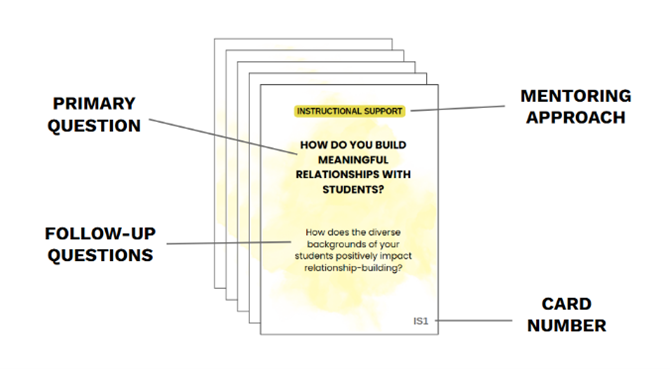
Although all three roles are essential, National Louis University and Northwestern University have partnered to explore innovative tools that enhance the mentoring experience, with a particular focus on Conversation Cards—a resource designed to improve the quality, frequency, and instructional focus of mentor–student teacher interactions during clinical experiences.
Research suggests that mentors often emphasize the relational aspects of mentorship, while student teachers tend to seek more instructionally focused guidance. To bridge this gap, our research and design team collaborated with mentor teachers, student teachers, and clinical supervisors to co-design Conversation Cards that:
- Foster a shared understanding of the mentoring relationship.
- Encourage deeper and more frequent instructional conversations.
- Strengthen mentors’ capacity to provide targeted, instructionally focused learning
One truth remains clear: the role of the mentor teacher is foundational in preparing the next generation of educators. In an increasingly complex educational landscape—where teachers must navigate shifting expectations, diverse classrooms, and evolving instructional practices—mentor teachers provide the steady guidance, insight, and encouragement that transform challenges into opportunities for growth. Through every conversation, observation, and moment of reflection, they help novice educators translate theory into practice, discover their professional identity, and find confidence in their voice as teachers. The influence of a mentor extends far beyond a single student teaching experience; it ripples through classrooms, schools, and communities, shaping the future of teaching—one conversation at a time.
Sources:
Two Sides of a Coin: Examining Mentor and Student Teacher Relationships During Student Teaching
Support for the Conversation Cards resource was provided through the CREATEd initiative of the Center for Research Use in Education, University of Delaware.
Written by: Lisa Mozer, Executive Director, Field Experience & School Partnerships at National Louis University
If you or your school would like to partner with National Louis University to host teacher candidates for field hours, student teaching, or year-long internships, please contact Lisa.Mozer@nl.edu.